Newsletter

Get weekly updates from Caroline all about golden age detective fiction.

The Man in the Dark

A closer look at John Ferguson's foggy 1928 "Ealing mystery".

Dear listeners,

It's Green Penguin Book Club time again! And we have reached the tenth crime, or green, title in the original Penguin series: The Man in the Dark by John Ferguson.

My copy is a 1952 reprint, by the way — I certainly don't have "full collection of first editions" money.

I had never heard of this book before I embarked on this reading project. That's one of the things that attracted me to doing this, actually. As well as getting to revisit some well-loved classics like The Unpleasantness at the Bellona Club by Dorothy L. Sayers and The Mysterious Affair at Styles by Agatha Christie, the requirement to read all of the Penguin crime titles in order brings me into contact with some books that were popular in their day but have long since rather faded from view. The Missing Moneylender by W. Stanley Sykes from earlier this year was definitely one of those and The Man in the Dark is another.

This book was first published in 1928 and joined the Penguin series in July 1936. It introduces a regular detective character for Ferguson, the Scottish private investigator Francis McNab, and also provides us with the first glimpse of a recurring Watson in the Fleet Street journalist Godfrey Chance. It's told in four "acts" that vary in format between third person narration, first person account and a witness statement. It straddles the divide between thriller and detective fiction.

As for what it's about, this summary from the inside cover of my edition does a rather good job of explaining:

That reads: "Murder on a foggy night at Ealing in the presence of a down-and-out who couldn't see the crime; a long car drive taking two people to hide for a while in the country; pursuit by journalists; a blind man's love affair; the criminal's escape finally and dramatically prevented. These are the ingredients of a part-mystery, part-adventure story which describes with equal brilliance and from both angles the problems of the hounds and the dodges of the hares."

I hope that has whetted your appetite for the episode, if not for the book itself!

📣
You can listen to this episode right now on all major audio platforms (just click the icon of your preferred app here to jump right in) as well as on the podcast's website, where there is also a full transcript to read if you prefer that. New episodes are also available on YouTube. If you're in the UK, you can listen ad free on BBC Sounds.

So who was John Ferguson? He wasn't a member of the Detection Club, nor did his ten crime novels foster him a reputation that lasted much beyond his death in 1952. He is an intriguing figure, nonetheless — an episcopalian minister from Perthshire in Scotland who lived all over the place, including in Guernsey and in Kent, and who wrote popular plays about Scottish history as well as crime fiction.

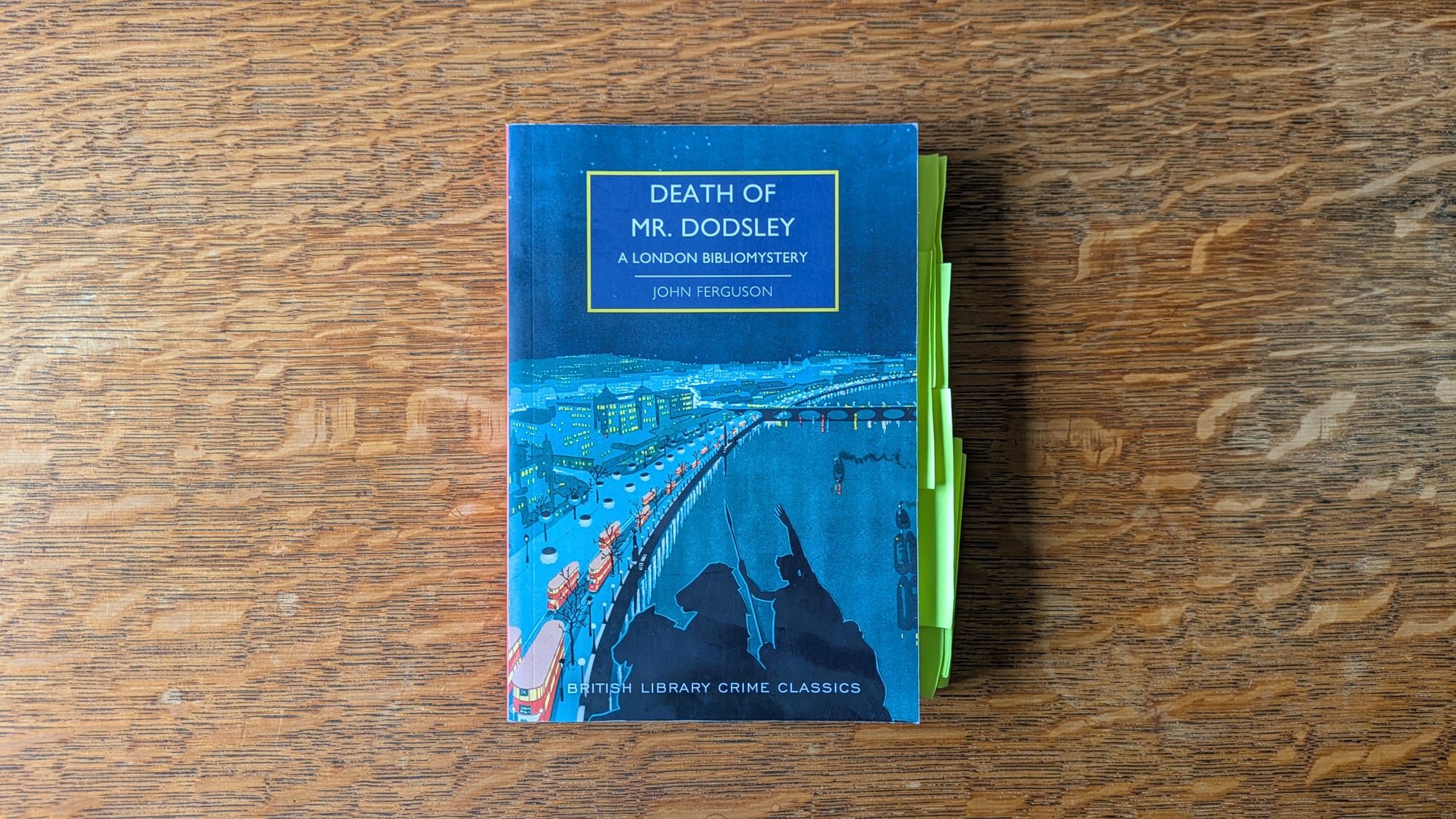
You might be slightly more familiar with one of his 1930s novels, Death of Mr Dodsley, because it was republished a couple of years ago by the British Library Crime Classics series. I reviewed this bookshop-based mystery in the most recent edition of our reading recommendations newsletter (I liked the setting but thought the pacing was off). I wanted to read another Ferguson title and Dodsley was the only one that I found to be readily available.

By the end of our discussion, my guest Kate Jackson (of the excellent Cross Examining Crime blog) and I had decided that, although we might not go rushing out looking for more John Ferguson books, we still felt curious about his work.

In her review of one of his other novels, Night in Glengyle, Dorothy L. Sayers expressed herself more taken with his pure thrillers than his novels of detection. She wrote that "in the excitement of the chase your reviewer quite forgot to be cunning and was properly taken aback by the surprise-packet at the end". I think I might like to try one of those and see if I feel the same.

His Guernsey-set novel Death Comes to Perigord also intrigues me, partly because I am curious about the place and partly because this was the book that enabled Ferguson to make the advantageous move from his previous publisher to the Collins Crime Club. Surely this means the book has some interesting features? If you have read this or any of his others, do let me know how you found them. You can reply to this email or leave a comment on the website.

The next book to get the Green Penguin Book Club treatment will be Penguin 78, Trent's Last Case by E.C. Bentley. Look out for that episode in September!

Until next time,

Caroline

You can listen to every episode of Shedunnit at shedunnitshow.com or on all major podcast apps. Selected episodes are available on BBC Sounds. There are also transcripts of all episodes on the website. The podcast is now newsletter-only — we're not updating social media — so if you'd like to spread the word about the show consider forwarding this email to a mystery-loving friend with the addition of a personal recommendation. Links to Blackwell’s are affiliate links, meaning that the podcast receives a small commission when you purchase a book there (the price remains the same for you).
Reading Recommendations: Ferguson, Kennedy, Rinehart, Osler

Dear listeners,

It's time for another monthly book recommendation newsletter, in which I and Shedunnit production assistant Leandra offer you a peek of our personal reading experience. There was some excellent chat in the comments of last month's edition, so if you have suggestions for what we should read next or thoughts about any of the books we mention after perusing the below, please do let us know.


The Death of Mr Dodsley by John Ferguson, still full of my tabs because it gave me an idea for a future episode of Shedunnit!
My copy is still full of my tabs because it gave me an idea for a future episode of Shedunnit!

Caroline Has Read: The Death of Mr Dodsley by John Ferguson

As I noted in last month's recommendations newsletter, the next title in the Green Penguin Book Club series is The Man in the Dark by John Ferguson from 1928. That episode will be coming out next Wednesday, 9th July, if you are eagerly anticipating it! The Death of Mr Dodsley from 1937 was the only other Ferguson novel that I could find in an easily-accessible edition (it was republished by British Library Crime Classics in 2023) so I read this as part of my preparation for the episode.

There lots of things to like about this book. It has a dramatic opening scene in the Palace of Westminster, as MPs are enduring an all night sitting of the House of Commons and waiting for an important vote on a key amendment. Meanwhile, at a secondhand bookshop on the Charing Cross Road, a bookseller named Mr Dodsley is being murdered while a drunk toff is giving two patrolling police officers the runaround on the street outside. There's even a cat that uncovers a key clue and a hand drawn map of the bookshop! All great fun.

Where this book fell short for me was in its pacing. After this promising start we spent what seemed like a very long time with a rather dull police inspector as he questions all the workers in the shop one by one, and this frankly felt repetitive and rather redundant. The narrative momentum improved again later on as Ferguson's recurring sleuth Francis McNab was able to take more initiative in the case, but to my mind the book never wholly recover from its slow middle section. A mixed experience, then, although reading this book has inspired an idea for another episode of the podcast that I hope you will get to hear in August.


Caroline Will Read: The Feast by Margaret Kennedy

In July, the Shedunnit Book Club has chosen to read a novel with a hotel or resort setting and picked this story set in a fading hotel on the coast in Cornwall in 1947. I had never heard of it before a member proposed that we read it, so I'm excited to get stuck in and find out what Kennedy did with this premise. All I know of her is that in 1924 she made a big splash with a book called The Constant Nymph, but given that more than two decades separate that from The Feast, I'm not assuming that they will have a lot in common.


Leandra Has Read: The Album by Mary Roberts Rinehart

The Album by Mary Roberts Rinehart

Last month, I promised to report back on my first experience with the "American Agatha Christie", aka Mary Roberts Rinehart. Originally published in 1933, The Album opens with the residents of Crescent Place discovering that one of them has been axed to death. The mystery becomes ever more twisted as more victims are slain one after the other.

Admittedly, I entered the novel with some apprehension! A friend of mine recently abandoned The Album, giving up halfway through it. Not to mention, I'm always suspicious of any comparison to Agatha Christie. And yet, I was pleasantly surprised. The conclusion to the mystery plot is outlandish, but I thoroughly enjoyed seeing the world through protagonist Louisa Hall's eyes. She is both sheltered and restricted by Crescent Place, a cul-de-sac impervious to the societal progress occurring outside these five Victorian mansions. In my mind, the murder mystery came second to her coming-of-age journey, as she discovers that she has options beyond a suffocating future at Crescent Place under her mother's thumb.

This slow burn mystery is nothing like any mystery by Agatha Christie that I have read, and readers will be disappointed if they enter it expecting this. With that said, I enjoyed the pacing, the many moments of humor, and Rinehart's observations on the changes to society and gender roles in the early 20th century.

Leandra Will Read: The Case of the Missing Maid by Rob Osler

This is the first in a new historical mystery series following junior detective Harriet Morrow in 1898 Chicago. Inspired by Kate Warne, the first female detective in the United States, Harriet applies for an open position at the Prescott Detective Agency in the Windy City. To everyone's surprise, she is not only hired as a probationary junior detective, but she receives her first case. Pearl Bartlett, owner of one of the most extravagant mansions on Prairie Avenue, believes her maid has been the victim of a kidnapping. No one else is willing to take this woman's claims seriously, and if Harriet can't get to the bottom of this missing person's case, her future at the Prescott Agency is at stake.

The Case of the Missing Maid is the selected read for another book club of which I am a member, and it has already received some early high praise from others members in the group. My mood has been drawing me to historical mysteries lately, which makes this the perfect next book for me. It also follows a queer main character sleuth, so even though Pride Month has just come to a close, there is never an "off season" for reading diversely!


That's what we've got coming up reading-wise. What are you planning to read this month? Let us know by replying directly or by leaving a comment to join the conversation with other readers. If you'd like to follow our reading adventures in between these posts, I (try to) publish monthly reading updates on my blog/newsletter and Leandra documents what she's reading on her YouTube channel.

Until next time,

Caroline

Links to Blackwells are affiliate links; if you make a purchase at this retailer the price remains the same for you but the podcast receives a small commission for referring you.

Inside The Poison Book

Dear friends,

It was last autumn, when I was rereading Agatha Christie's The Mysterious Affair at Styles for the Green Penguin Book Club episode on that book, that I began to wonder what the point of the "poison book" really was.

I'm sure you have come across this phenomenon in Christie and other golden age detective fiction too: a character wants to buy a poison and in order to do so she must put her name and address in a book or register kept by the retailer. Often this entry is later shown to be falsified by the subsequent murder investigation, but there never seems to be any serious penalty for this fraud. It's usually just one clue among many others and it didn't seem to be a deterrent to any would-be poisoners. So why do these books even exist?

To find out, I asked Dr Kathryn Harkup, chemist and author of science books including V is for Venom: Agatha Christie's Chemicals of Death, to return to the show to guide me through the twists and turns of nineteenth century pharmaceutical regulation in Britain. Because that is where the poison book originated — with the Arsenic Act of 1851.

Partially in response to arsenic's growing reputation as a deadly and highly available domestic poison, the government made its first attempt to curb who could get their hands on dangerous chemicals. As you'll hear in today's new episode, two more laws followed in the subsequent decades which tried (with limited success) to improve the situation. But by the time the books you'll hear us talking about (see below!) were published in the 1920s and 1930s, the poison book was still such an accepted part of the British shopping experience that interwar crime writers felt no need to explain it to their readers.

📣
You can listen to The Poison Book episode right now on all major audio platforms (just click the icon of your preferred app here to jump right in) as well as on the podcast's website, where there is also a full transcript to read if you prefer that. New episodes are also available on YouTube. If you're in the UK, you can listen ad free on BBC Sounds.

As Kathryn and I were planning this episode, we went back and forth on whether it made more sense to look at this subject in terms of the legislative chronology or through the golden age detective fiction in which the poison book appeared. Ultimately we decided to go through the laws in order and talk about the different questions that arose in each novel as we came to them. I thought I might just give you a little taster of the books we covered here before you dive into the full episode.

Obviously we talked about The Mysterious Affair at Styles, with its fiendish poisoning plot and clever use of the poison book. But we also covered Strong Poison by Dorothy L. Sayers in some detail, since the poison book is a major piece of evidence in the trial of Harriet Vane with which the novel opens. Vane, of course, is accused of poisoning her former lover with arsenic, and her defence is complicated by the fact that she freely admits she had been buying the drug and signing false names for it as part of research for a novel! During our conversation, Kathryn wondered whether Dorothy L. Sayers had ever tested this out for herself, and now I can't stop thinking about this myself. She was so keen on accuracy...

Another title I greatly enjoyed diving into for this episode was Family Matters by Anthony Rolls (keen newsletter readers may remember me mentioning this in our most recent "Reading Recommendation" post). I've never read anything like the poisoning plot in this book and it was fascinating to hear Kathryn's take on the science of it. It also demonstrates another way in which the poison book system was ineffective at preventing crimes. At least one of the substances in this story is known to be highly toxic yet is exempted from the provisions of the law, making it freely available to purchase everywhere. Gulp.

With so much discussion of arsenic, we had to delve into The Wychford Poisoning Case by Anthony Berkeley too. Aside from a couple of bizarre spanking-based scenes (!), this novel is an excellent retelling of the Florence Maybrick case from the 1880s. Berkeley relocates it from Liverpool to the Home Counties and updates the period to the 1920s, but keeps the "too much arsenic" problem that was central to the real-life case.

My memories of this book from when I made the Anthony Berkeley episode with Martin Edwards back in 2020 were that it wasn't that good, but I was pleasantly surprised when I revisited it last month. Some of Roger Sheringham's antics did make me roll my eyes, but Berkeley's facility with turning actual murders into clever fiction was more impressive this time round.

As an extra bonus for loyal newsletter readers who have made it this far, I thought I would also flag a short story that we did discuss, but that had to be cut from the main episode for time. This is “The Boat Race Murder” by David Winser from 1942, which can be found in the British Library Crime Classics anthology Setting Scores. This features the misuse of a patent medicine and the falsification of a poison book... David Winser was both a rowing blue and a medical student, so it's safe to assume that at least some of this story drew on his own experiences. He was sadly killed in action in WW2 in 1944 and so did not live to write more crime fiction, but this story is well worth looking up, I recommend it.

And do let me know as you are reading around the classic crime genre if you discover any other interesting instances of the poison book in golden age detective fiction. I have a feeling that I am only at the beginning of my obsession with this...

Until next time,

Caroline

You can listen to every episode of Shedunnit at shedunnitshow.com or on all major podcast apps. Selected episodes are available on BBC Sounds. There are also transcripts of all episodes on the website. The podcast is now newsletter-only — we're not updating social media — so if you'd like to spread the word about the show consider forwarding this email to a mystery-loving friend with the addition of a personal recommendation. Links to Blackwell’s are affiliate links, meaning that the podcast receives a small commission when you purchase a book there (the price remains the same for you).