
The Journey of Ariadne Oliver
Putting Agatha Christie's alter ego in the spotlight.
Dear listeners,
One of the many things that fascinates me about Agatha Christie's detectives is that I don't think she knew at the beginning how many times she would end up writing about them. The idea of the crime series built around a central sleuthing personality is so embedded now that I suspect most debut novelists have half an eye on the sequel potential of their protagonist even as they are constructing their first case. Not only did Christie not begin her first novel expecting to become a professional writer with a career spanning decades, she also didn't have ten Poirot sequels already in mind.
This is surely especially true of Mrs Oliver, who first shows up as a minor character in the Parker Pyne story "The Case of the Discontented Soldier", written in the early 1930s. I don't think Christie knew then that she would go on to write seven novels featuring this character, one of which has her as the sole detective. The evolution of Mrs Oliver (who acquires her first name, Ariadne, in her first novel length appearance) is fascinating, therefore. She grows and changes to meet the demands of each new novel that Christie wanted to put her in, rather than being a fixed personality that is slotted in, ready made, to new stories.
In the latest episode of Shedunnit, I've gone more deeply into the form and function of Ariadne Oliver in Christie's mysteries, and looked at the relationship between creator and character. Ariadne is often described as being a stand-in or self-insert for Agatha Christie herself. But is that really true?
Let's take a look at the full Ariadne Oliver canon.
Cards on the Table (1936)
This is a clever piece of formal experimentation that puts me in mind of some of Anthony Berkeley's 1930s detective fiction. An eccentric host invites four people he suspects of having got away with murder and four detectives to his house for dinner and cards. By the end of the night, he is dead, stabbed by one of his guests. Who did it? The personalities at the party, as revealed by their bridge playing, is vital to the solution of the case. It's something of a detecting super-group, with Christie bringing together four detectives she had used separately in other works: Hercule Poirot, Mrs Oliver, Colonel Race and Superintendent Battle. I like this book both for its cunningly-handled murder scenario and because it sets up what was to become a close and long-term relationship between Mrs Oliver and Poirot.
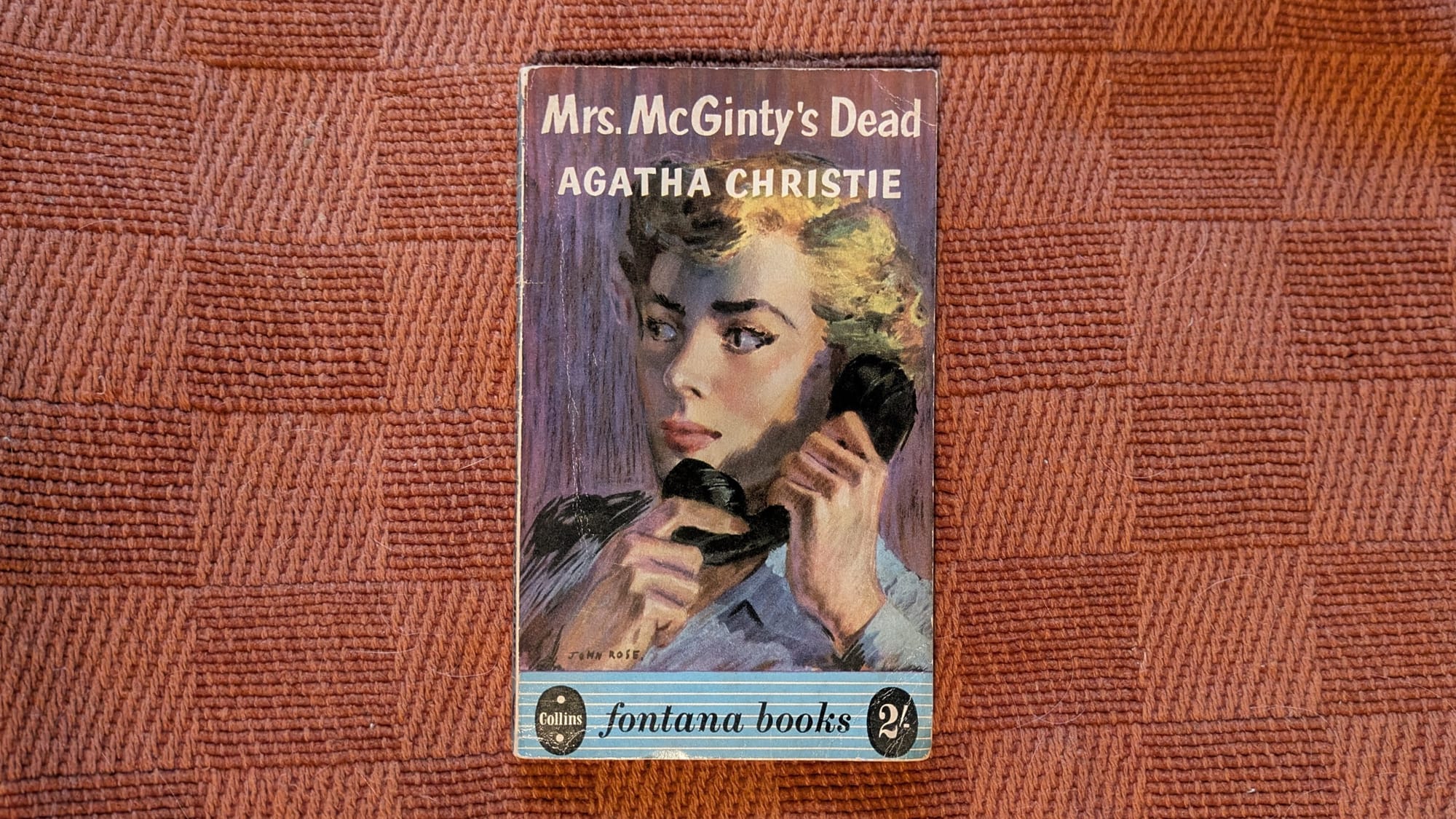
Mrs McGinty's Dead (1952)
After leaving Mrs Oliver in stasis for 16 years, Christie brought her out to act as a secondary to Poirot in this village mystery about the brutal murder of a cleaning lady. She is there by coincidence, not design, being introduced as an acquaintance of one of the households. She is working on a stage adaptation of one of her novels with someone who lives there — a reflection of the fact that Christie herself was also moving more into theatrical writing in the early 1950s.
Dead Man's Folly (1956)
This time, it is Mrs Oliver who calls in Poirot, but not initially to investigate a murder. She is staying at a country house (Greenway in disguise) and has been asked to create a murder mystery treasure hunt for the village fête. She is feeling uneasy about the process, but can't quite put her finger on why — a Mrs Oliver trademark. Certain aspects of her mystery are being changed as if someone is manipulating her for their own nefarious reasons. Not long after Poirot joins her, the murder mystery game becomes a real murder and we get to see Mrs Oliver in a more active sleuthing role. I especially like the evolution of her much discussed "women's intuition" from earlier stories. We see how seriously Poirot takes Mrs Oliver's feelings that something is not right in this book.
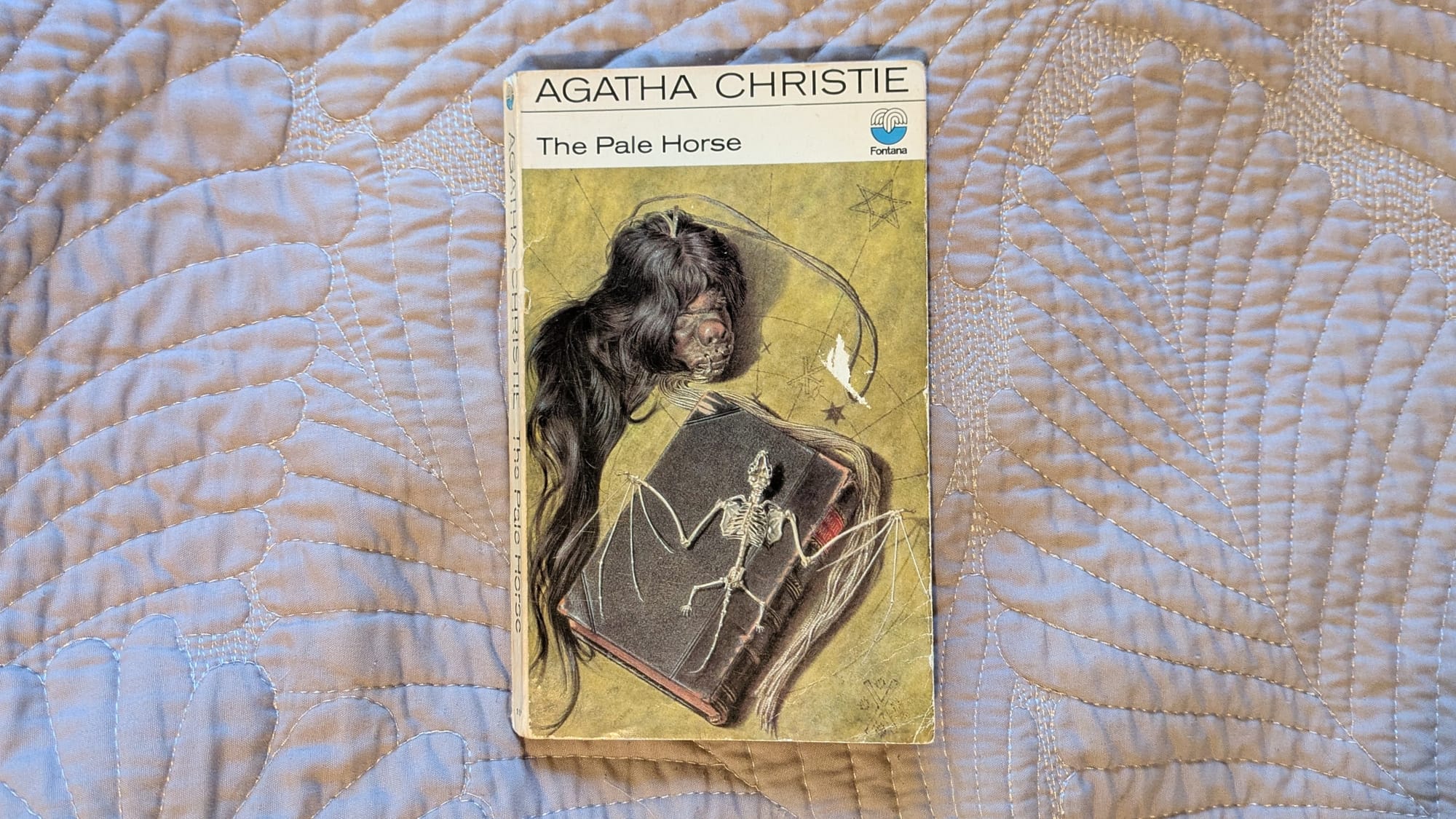
The Pale Horse (1961)
This is the only full-length novel in which Mrs Oliver appears without Poirot. She is consulted by the book's narrator, Mark Easterbrook, about another murky suspicious circumstance that may or may not be criminal: the possibility that a group of creepy women living in an old pub are running a magical "assassination to order" business. Through Mark's eyes, we get to see some of Mrs Oliver's creative process for her fiction and we learn that she had written 55 novels and counting. She gives him good advice about confronting evil. This book is also a key crossing-over point in the Christie canon. One of the characters from Cards on the Table recurs as a way to connect Mrs Oliver to the social circle and the area where the Pale Horse pub is. Also based here is the vicar's wife Mrs Dane Calthrop, who appears in 1942's The Moving Finger as the person Miss Marple is staying with while investigating poison pen letters in Lymstock. Thus, this novel confirms that Poirot and Marple exist in the same fictional universe, since via Mrs Oliver they now have a friend in common. I highly doubt that Christie thought or cared about such a detail, but I enjoy thinking about it.
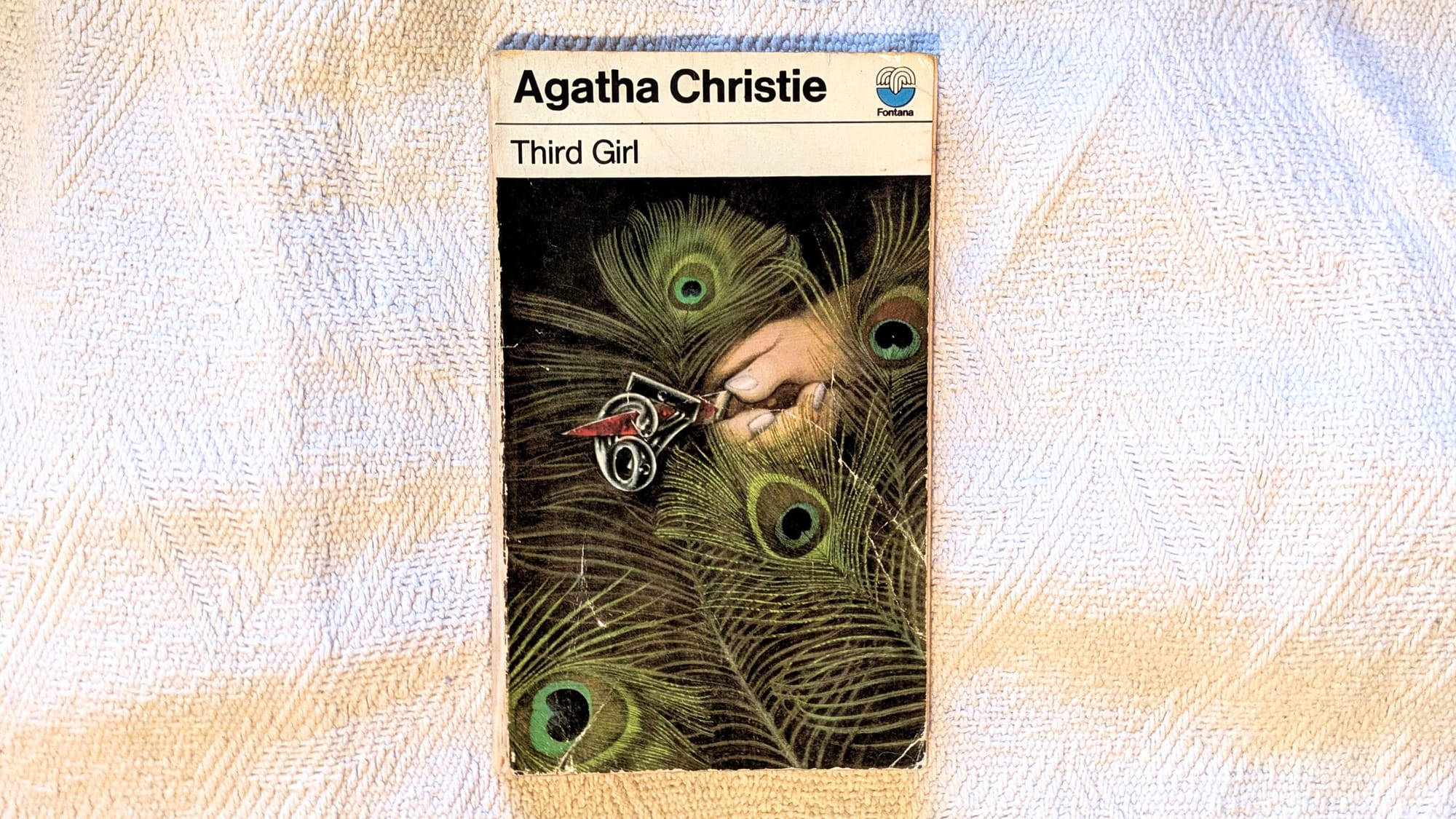
Third Girl (1966)
This is a less successful crime novel (Christie tries to write about drugs and youth culture, topics that don't suit her) but we still get some good Mrs Oliver moments, such as her request to Poirot that he be the guest speaker at the "Detective Authors' Club" annual dinner, thereby confirming that she is a member of a Detection Club equivalent. Christie, by the way, was the president of the real-life Detection Club when she published this novel. This book also contains some good examples of Mrs Oliver's compassion, particularly for girls and young women, and perhaps my favourite sequence hers of all, where she briefly turns shoe-leather detective and trails a suspect across London.
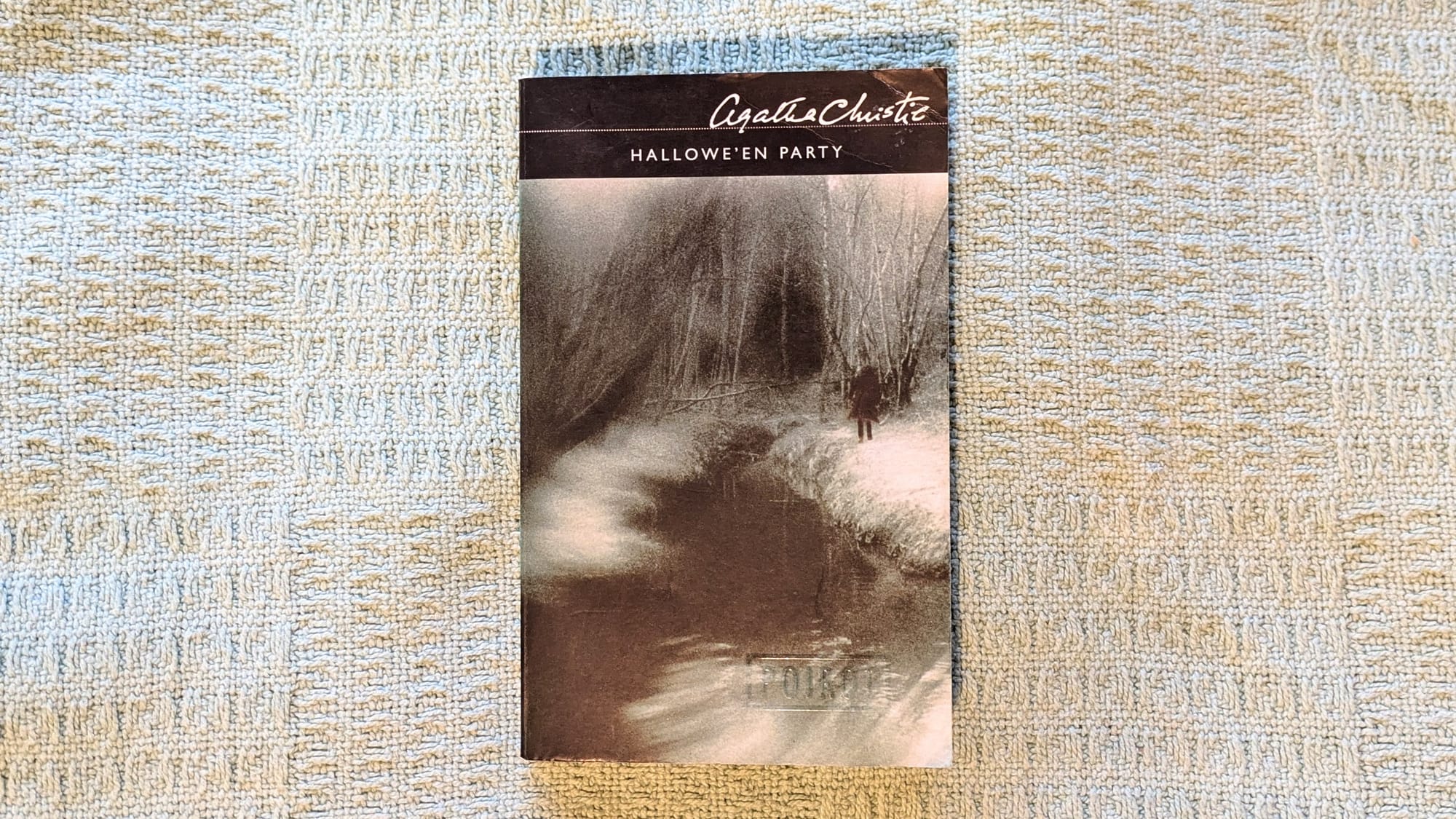
Hallowe'en Party (1969)
These days, I think people mostly read this book for the seasonal vibes rather than the mystery, which is probably as it should be. The opening chapter where Mrs Oliver is helping out at her friend's children's Halloween party is lovely. The book is interesting for the scholar of Ariadne Oliver, though, because as in Dead Man's Folly she has to confront the fact that her presence might have precipitated an until-then theoretical murderer into taking practical action. Once again, Mrs Oliver summons Poirot onto the investigation, confirming that their connection remains close and strong 35 years on.
Elephants Can Remember (1972)
My overwhelming feeling about this book is that it is very sad. Its subject matter is deeply tragic — more so than the average Christie mystery — and its thematic focus on ageing and memory is melancholy, too. Mrs Oliver wrestles (as Christie probably was too, four years before her death) with feelings about being an old woman, the world having changed around her, and not being able to rely on her own memory as she once did. I don't love this novel or yearn to re-read it often, but as I looked at it again for this episode I came to see it as a fitting conclusion for a character who had spanned so much of her creator's career and become a vessel for many of her own preoccupations.
I hope you'll enjoy listening to this episode — Agatha and Ariadne — and I'll be back with you next Wednesday with our monthly reading recommendations.
Until then,
Caroline
You can listen to every episode of Shedunnit at shedunnitshow.com or on all major podcast apps. Selected episodes are available on BBC Sounds. There are also transcripts of all episodes on the website. The podcast is now newsletter-only — we're not updating social media — so if you'd like to spread the word about the show consider forwarding this email to a mystery-loving friend with the addition of a personal recommendation.