Murder at the Bookshop
Here are some bibliomysteries that you might want to try.
Dear listener,
For today's episode, I am looking at a setting that I suspect is very familiar to all of us avid readers: the bookshop.
A couple of months ago, I was reading Death of Mr Dodsley as part of my preparation for the Green Penguin Book Club episode about The Man in the Dark by John Ferguson. There were lots of things I liked about Mr Dodsley — the opening in the House of Commons, the character of private detective Francis McNab, his interactions with the police detectives — but above all what impressed me was how well Ferguson had integrated the bookshop setting into his murder plot. It wasn't an accident that this bookshop on the Charing Cross Road in London had ended up playing host to a corpse: the selling of books is integral both to the murderer's actions and the detective's methods in discovering them.
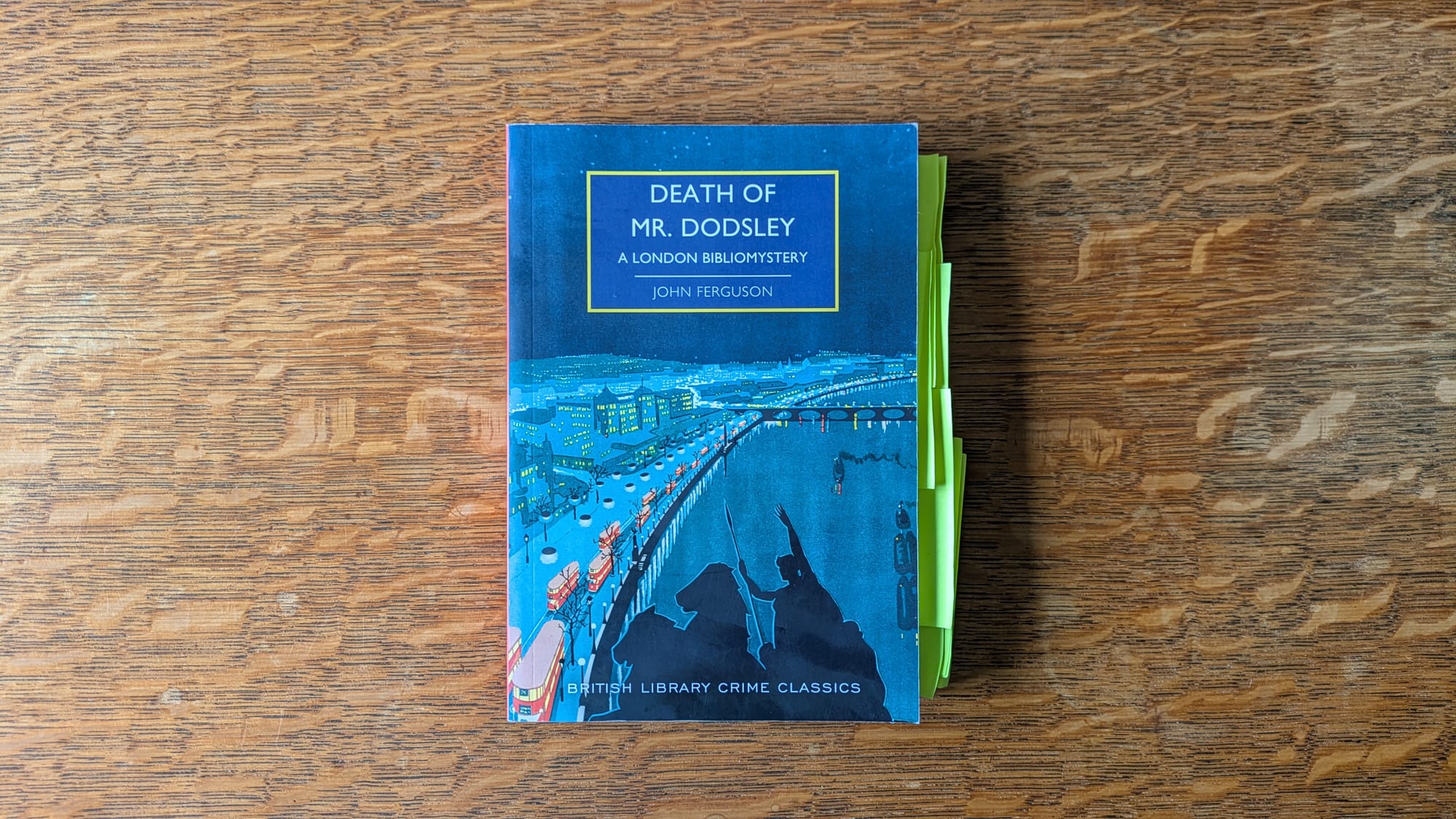
This book prompted me to wonder: are there many other golden age era murder mysteries that take advantage of a bookshop setting in this way? And so, today's episode came to be — an investigation of Murder at the Bookshop.
Since in the episode I focused less on the individual books and more on the thematic correspondences between them, I thought that here I would offer you a brief introduction to each title I talked about so you can see if you would like to add any of them to your reading list.
Beginning With A Bash by Phoebe Atwood Taylor
This 1937 novel is part of the American golden age, which was comprised of work by US-based writers who chose to follow the puzzle-based fair play conventions popular in the UK during the interwar years rather than the hardboiled noir tradition then popular in their own country. Phoebe Atwood Taylor was a prolific crime writer from Boston, best known for her detective Asey Mayo, who was nicknamed the "Codfish Sherlock" because so many of his adventures take place in and around Cape Cod. I sampled one of these for myself for the Agatha Christie's Taste in Crime Fiction episode earlier this year.
Beginning with a Bash appeared under her Alice Tilton pseudonym and was the first in a series about a schoolteacher-turned-detective named Leonidas Witherall. At the start of this book, Witherall (who we are repeatedly told looks exactly like the well-known portrait of Shakespeare) is working as a janitor for a secondhand bookshop in Boston. The shop has recently been inherited by one Dot Peters, and on a particularly cold Saturday afternoon in the depths of winter, a former student of Witherall's named Martin Jones is chased into the shop by the police, wrongly accused of a theft. Then the body of a customer, a professor, is found among the untidy stacks, and Jones is arrested for the murder. Leonidas, Dot, and a Boston society matron called Agatha Jordan who also happened to be in the shop at the time of the crime decide to find the real culprit before Jones can be charged on the Monday morning. The ensuing hijinks see them discover a secret passage, get drawn into some gang warfare, and experience multiple car chases and shootouts. This is not an especially serious book, but there are sufficient puzzle elements to please the golden age fan who enjoys a lighter sort of adventure. I suspect fans of Agatha Christie's Tommy and Tuppence books might like this one.
Murder in the Bookshop by Carolyn Wells
Another American title, this time set in New York and published in 1936. Carolyn Wells was an exceptionally prolific author, publishing over 170 books in her lifetime. This was the 46th of the 62 books she wrote featuring private detective Fleming Stone. She really belonged to an earlier era of crime writing — she lived from 1862 to 1942 and cited Anna Katharine Green as a major influence. The puzzle elements of this tale about an obsessive and wealthy book collector murdered in the act of acquiring a valuable book signed by Founding Father Button Gwinnett are a bit sketchy, but it can still be enjoyed as a superficial romp.
Death in a Bookstore by Augusto De Angelis
Meanwhile, I was very glad to have started this project so that I ended up reading this book, first published in Italy in 1936. Augusto De Angelis was an Italian journalist who wrote 20 crime novels starring Commissario Carlo De Vincenzi of the Milan police. According to De Angelis's grandson, who wrote the introduction to the Kazabo edition, he has a claim to have created the first truly "Italian" detective (as opposed to previous characters who were clearly transplanted pastiches of pre-existing sleuths such as Sherlock Holmes). De Angelis was also a staunch anti-fascist who was murdered by Mussolini supporters in 1944.
Originally titled Sei donne e un libro (Six Women and a Book), this mystery follows Inspector De Vincenzi as he investigates the murder of a prominent Milanese surgeon and politician, who has been found dead in the backroom of a rather down at heel secondhand bookshop. The case takes him into the world of illicit book dealing and spiritualism societies, which was an interesting callback to an old episode, Knock Knock, about seances in mysteries. Above all, what impressed me about this book was the depth of De Vincenzi's character: he is a quiet, philosophical man who takes beliefs different to his own seriously. Above all, he just wants to escape Milan to the countryside so he can see the stars and think about the meaning of life. I'm so pleased to have discovered him and look forward to reading more of De Angelis's work.
Bodies in a Bookshop by R.T. Campbell
This book by the poet Ruthven Todd from 1946 probably dies with Death of Mr Dodsley as the best-plotted mystery I read for this episode. Todd was advised by his poet friend Cecil Day Lewis (aka Nicholas Blake) to write detective fiction as a means of supplementing his income, but to do it under a pseudonym so as not to sully his poetic reputation. Todd produced eight novels featuring a botanist-detective, Professor John Stubbs, in a very short space of time (under two years, I believe), but discontinued the enterprise when his publisher went bankrupt. This is the first of them that I have read and I enjoyed it very much until about four-fifths of the way through, when I began to feel rather let down by the solution.
Bodies in a Bookshop is narrated in the first person by Stubb's assistant and "Watson" figure, Max Boyle. One of the things I liked best about this book was Boyle's antipathy for his boss; no fawning adulation to be found here. Soon after discovering two bodies in a bookshop, Boyle says:
"If I wasn’t careful I would be hauled in as his Watson once again; I have no liking for playing Watson to the old man’s Sherlock. I haven’t the right kind of mind. I am not suitably astonished when he produces the solution like the rabbit from the conjuror’s topper. Much as I admire the Professor I have to confess that he irritates me almost beyond endurance."
Their bickering dynamic was great fun to read, complemented by the serene presence of a Scotland Yard inspector who thinks they are both ridiculous. There is also some decent critique of the detective fiction form in this book, with Stubbs being called out on his supposedly empirical method of detection, which really just involves accusing everyone in turn of the crime until he hits upon the right solution. Ending notwithstanding, this was another book I was glad to have thrown into my path and I hope to try more of the R.T. Campbell output in future. I'm intrigued by his debut, Unholy Dying, which is apparently set in Edinburgh at a conference of geneticists.
I hope you find something there to investigate further! I look forward to hearing about your bookshop mystery reading at a future date.
Until next time,
Caroline
You can listen to every episode of Shedunnit at shedunnitshow.com or on all major podcast apps. Selected episodes are available on BBC Sounds. There are also transcripts of all episodes on the website. The podcast is now newsletter-only — we're not updating social media — so if you'd like to spread the word about the show consider forwarding this email to a mystery-loving friend with the addition of a personal recommendation. Links to Blackwell’s are affiliate links, meaning that the podcast receives a small commission when you purchase a book there (the price remains the same for you).